Introduction
Thrips are a persistent challenge for berry growers, particularly in blueberries and strawberries, where feeding damage can directly affect fruit quality and marketability, as well as influence the plants growth. These tiny insects can be difficult to detect, and populations may increase rapidly under favourable conditions. Effective management therefore depends on early detection and preventative control.
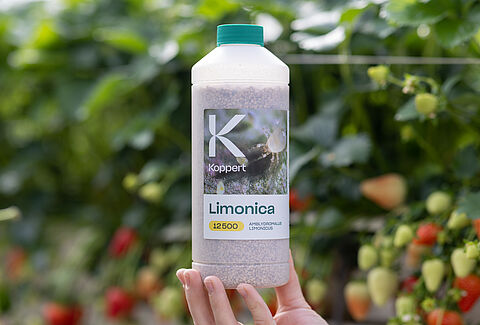
Predatory mites offer growers a biological control option as part of an integrated pest management (IPM) programme. One such predator is Amblydromalus limonicus, a generalist predatory mite and although its potential as a biological control agent for thrips had been recognised for many years, it was only commercialised in 2012 by Koppert and is now called Limonica.
Getting to Know the Predator
Limonica is a generalist predatory mite that feeds on thrips larvae, whitefly eggs and young stages, spider mites and other small insects. It can also feed on pollen, allowing it to survive when pest numbers are low and making it a valuable predator for preventative IPM programmes in berry production.
Temperature plays an important role in their development. Under suitable conditions, Limonica can develop from egg to adult in approximately six days at 25°C. Development takes around ten days at 20°C and 15 days at 15°C. Although development is possible from 10°C, it becomes considerably slower.
Humidity and food availability also influence establishment and reproduction. Low humidity can negatively affect egg hatching, larval survival and development. Maintaining healthy, well-watered plants can help create a favourable microclimate around the leaf surface, where the mites live.
Understanding Limonica's feeding behaviour and environmental requirements helps growers determine where it fits into a berry IPM programme. However, it is also important to understand how it compares to other commonly used predatory mites.
Limonica, Swirski (Amblyseius swirskii) and Thripex (Neoseiulus cucumeris) all play a role in thrips management, but their differences in feeding preferences, temperature tolerance and target pests can influence which predator is best suited to a particular crop and growing environment. The table below highlights these differences and helps explain where Limonica offers potential advantages in berry production.
| Predator | Limonica | Swirski | Thripex |
| Thrips control | 1st and 2nd larval stages | Mainly 1st larval stage, and sometimes 2nd larval stage | Mainly 1st larval stage |
| Feeding rate on 1st instar thrips per day at 25°C | 7 | 4 | 6 |
| Whitefly control | Yes, eggs and larvae | Yes, eggs and larvae | No |
| Alternative food | Pollen and other small prey | Pollen and other small prey | Pollen and other small prey |
| Most effective temperature range | 13–30°C | 20–32°C | 15–25°C |
Using Limonica in Berry Production
Bottles or Ulti-Mite sachets?
Koppert supplies Limonica in two formats: bottles for direct crop distribution and Ulti-Mite sachets, which provide a more continuous release of predators over time.
Bottle applications allow growers to distribute predatory mites directly into the crop. They can be useful when introducing predators across a growing area or targeting specific hotspots, depending on the application strategy.
Ulti-Mite sachets provide a gradual, continuous release of predatory mites. This helps maintain their presence in the crop over time and can reduce the need for repeated manual releases.
Both formats can contribute to effective thrips management when used at the appropriate rate and time. The most suitable option depends on pest pressure, crop conditions and the overall IPM programme.
What did the blueberry Ulti-Mite trial show?
A blueberry trial conducted in the Western Cape evaluated Limonica Ulti-Mite sachets at different application rates against a control block which used a bottle formulation. The treatments included 500, 750 and 1,000 sachets per hectare.
The results highlighted three important findings:
- Thrips suppression: Average thrips counts in the control block were consistently higher than in the Limonica-Ulti-Mite treated blocks.
- Predator populations: Average predator counts were higher in the Limonica Ulti-Mite blocks compared to the control.
- Best thrips control: The treatment using 1,000 sachets/ha provided the strongest overall suppression of thrips.
These findings demonstrate the potential of Limonica Ulti-Mite sachets for thrips management in blueberries. The 1,000-sachet rate provided the strongest thrips suppression, while the other dosages also provided good suppression. But for all dosages, a better establishment of Limonica was seen using the Ulti-Mite sachets compared to the bottles.
When should Limonica be released?
Timing is critical for successful biological control. Limonica should ideally be introduced as early as possible, while thrips populations are still low.
In blueberries, introductions can begin around flowering, when pollinators are active in the crop, or when fruit development starts. The exact timing should be guided by crop development, pest monitoring and the grower's IPM programme.
Early introduction allows predators to establish before thrips populations increase. This can improve preventative control and potentially reduce the number of mites required compared with introducing them after a severe infestation has developed.
How much Limonica should be released?
For blueberries, typical application rates are:
- Bottle applications: 100,000–250,000 predatory mites per hectare.
- Ulti-Mite sachets: 500–1,000 sachets per hectare.
The appropriate rate depends on initial thrips pressure, crop conditions and the desired level of control. Where pest pressure is high, a more intensive strategy may be required.
Consult your Koppert technical advisor for recommendations suited to your production system and the conditions in your crop.
Check your chemicals
Chemical compatibility is essential when introducing predatory mites. Some insecticides, fungicides and other crop protection products can negatively affect beneficial organisms directly or indirectly.
Before releasing Limonica, review recently applied products and those planned for use during the season. Where possible, select compatible products and allow appropriate intervals between chemical applications and predator releases.
Your Koppert technical advisor can assist with evaluating product compatibility and integrating Limonica into your existing spray programme.
| Active ingredient | Spinetoram | Acetamiprid | Metarhizium amisopliae | Bacillus thuringiensis | Cyprodinil + fludioxonil | Fluopyram |
| Effect on Limonica | 2 W | 1 W | 0 W | 0 W | 0 W | 0 W |
| Impact of compounds on beneficial population | Persistence | |
| 0-25% mortality | Low impact on beneficials | "Number" W Representing the number of weeks you must wait before releasing the specific beneficials |
| 25-50% mortality | Minor impact on beneficials | |
| 50-75% mortality | Harmful to beneficials | |
| 75-100% mortality | Toxic to beneficials | |
Why Choose Limonica?
Predatory mites are an important component of integrated thrips management because they provide biological control directly within the crop. Limonica offers several advantages for berry growers:
- Effective feeding: It actively searches for thrips and can attack different larval stages, including second-instar western flower thrips. Searching for thrips where contact chemicals can not.
- Flexible diet: It feeds on thrips, whiteflies, spider mites, other small insects and pollen, supporting survival when thrips numbers are low.
- Rapid development: Under suitable conditions at 25°C, it can complete its life cycle in approximately six days.
- Continuous release & preventative control: Ulti-Mite sachets support gradual release and sustained predator presence in the crop, giving long-term control.
While other predatory mites also play an important role in thrips management, Limonica's high feeding rate, wide temperature tolerance, ability to feed on a range of prey and attack older thrips larvae makes it a valuable option for berry IPM programmes.