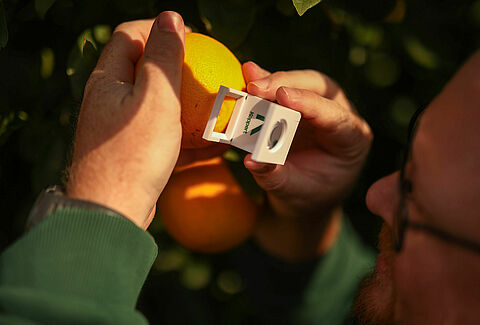

Citrus red mite and two-spotted spider mite are important pests of citrus that can cause significant damage when populations are not managed effectively. Their feeding can cause leaf discolouration, stippling, and bronzing, while severe infestations may result in premature leaf drop, reducing the tree’s photosynthetic capacity and potentially affecting yield. Feeding damage on fruit can also cause bronzing and russeting of the fruit surface, reducing its visual quality and marketability.
The rapid development and reproductive capacity of these pests make early detection and preventative management critical.
Understanding the biology
Both mite species have relatively short life cycles, allowing multiple generations to develop during a season. Temperature has a major influence on their development, with increasing temperatures generally accelerating their life cycle and reproductive rate.
Two-spotted spider mite females can produce approximately 5–10 eggs per day under favourable conditions, allowing populations to increase extremely rapidly. Citrus red mite is similarly capable of rapid population growth.
Favourable conditions include warm temperatures, dry conditions, plant stress, and reduced natural-enemy activity. Broad-spectrum pesticide applications can further contribute to outbreaks by disrupting naturally occurring predatory mites and other beneficial organisms.
Under these conditions, populations can increase exponentially if not controlled. This makes controlling mites while populations are still low far easier than attempting to correct a severe infestation.
Read the full article here: https://issuu.com/cariendaffue/docs/vegetables_fruit_september_october_2026?fr=sOWU5NDgzNzEzODE