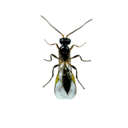
For trapping whiteflies, thrips , leaf miner and fungus gnats in hot spots or places where high pressure can be expected, such as along gables, ventilation windows and (other) draughty places. Pests W
Pests Two spotted spider mite ( Tetranychus urticae ); European red mite ( Panonychus ulmi ); citrus red mite ( Panonychus citri ); other spider mite species. Crops Do not use in tomato. Mode of actio
Pests Especially for cotton aphid ( Aphis gossypii) ; tobacco aphid ( Myzus persicae var. nicotianae ); peach-potato aphid ( Myzus persicae var. persicae ). Mode of action Adult parasitic wasps emerge
Pests Two-spotted spider mite ( Tetranychus urticae ) and other Tetranychus spp., except Tetranychus evansi . Mode of action Predatory mites use their piercing mouthparts to extract the contents of th
Pests Young larvae of various thrips species. Crops Do not use in tomato. Mode of action Predatory mites use their piercing mouthparts to extract the contents of their prey. Pack size 100,000 predator
Pests Larvae of various species of thrips (first and second larval stages); eggs and larvae of greenhouse whitefly ( Trialeurodes vaporariorum ) and tobacco whitefly ( Bemisia tabaci ). Crops Do not u
Pests Young larvae of various thrips species. Crops Do not use in tomato. Mode of action Predatory mites multiply in the sachet and disperse into the crop over a period of several weeks. Predatory mit
Pollination of isolated crops, produced on a smaller scale, such as seed crops with just a few flowers or for crops that produce very little pollen. Crops Members of the cruciferae, compositae, umbell
Pests Various species of thrips . Crops Do not use in tomato. Mode of action The predatory bugs actively search for prey. With their piercing mouthparts, they extract the contents of their prey, leavi