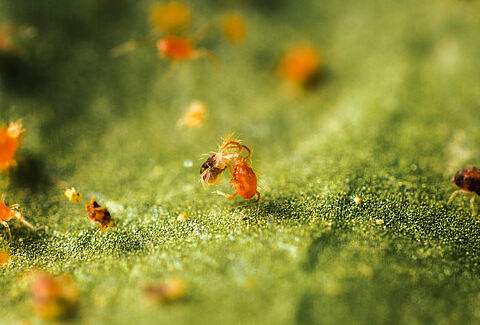
Managing Two-Spotted Spider Mite in Berry Crops Through Biological Control
Two-spotted spider mite (Tetranychus urticae) is one of the most common mite pests in agricultural production and can cause significant damage across a wide range of crops. Its high reproductive rate and tendency to establish on the undersides of leaves make it particularly challenging to manage. In berry crops, especially strawberries and raspberries, infestations can reduce plant vigour, cut yields, and compromise fruit quality.
Managing this pest is becoming increasingly challenging due to poor contact between chemical applications and mites, concerns regarding pollinator safety, maximum residue limits (MRLs), and the limited availability of effective chemical control options (resistance development). Chemical control programmes often require multiple applications throughout the season, which can be difficult to manage within residue restrictions and resistance management strategies.
In 1967, Koppert commercialized a biological solution for two-spotted red spider mite Spidex (Phytoseiulus persimilis) and later for Spical (Neoseiulus californicus). These predatory mites provide a complementary approach to sustainable spider mite control and have become the cornerstone of integrated pest management (IPM) programmes across various crops. They provide effective pest suppression while reducing reliance on chemical applications and the associated risks, including resistance development, residue concerns, and potential harm to beneficial organisms.
Know Your Target: Two-Spotted Spider Mite
 OLYMPUS DIGITAL CAMERA
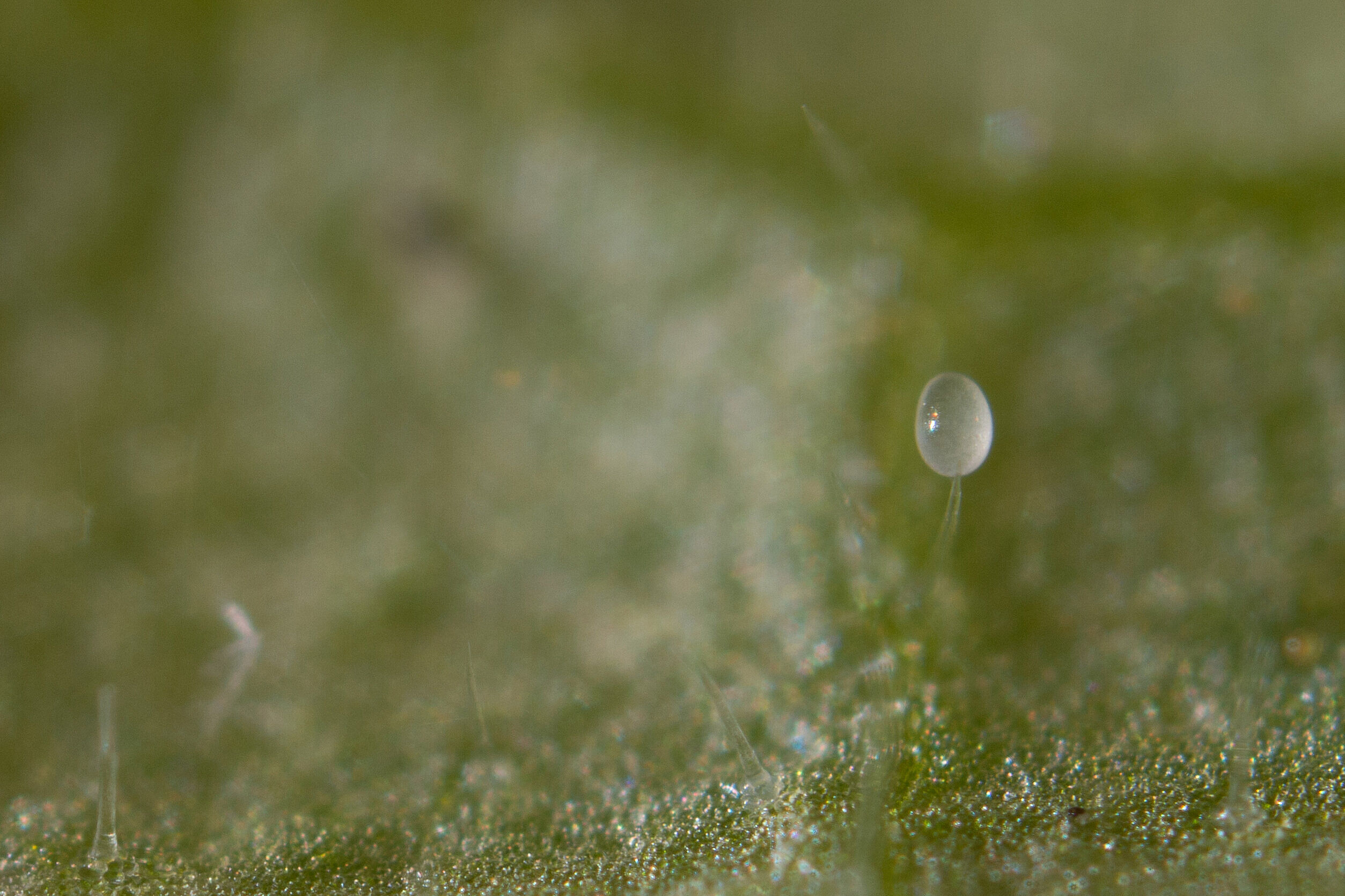
Two-spotted spider mite (Tetranychus urticae), commonly known as red spider mite, is a widespread pest affecting berries and many other crops. Its rapid reproduction and ability to spread make it a significant challenge for berry growers.
Population development: Temperature is the main factor influencing development, with populations growing rapidly under favourable conditions. At approximately 25°C, females can lay more than ten eggs per day, allowing populations to increase rapidly. Lower relative humidity can further encourage egg-laying, depending on the conditions and mite population.
Damage symptoms: Mites feed on plant cells, mainly on the undersides of leaves, causing yellow stippling, discolouration and reduced photosynthesis. Severe infestations can result in leaf drop, reduced plant growth, fine webbing across affected plants and damage to fruit quality.
Dispersal: Mites spread between touching plants, through wind and via infested plant material, clothing and equipment.
Their ability to multiply quickly and spread unnoticed makes early detection and consistent monitoring essential. By the time visible damage appears, populations may already be well established. Integrating biological control agents such as Spical and Spidex into an IPM programme helps growers manage populations before they reach damaging levels.
Scouting
Start with scouting; this is crucial to implement an effective IPM program. It will allow growers to know exactly what is happening in their crop before acting, and allow for the correct product to be selected and the timing of application. The crops should be scouted systematically and regularly (once a week), paying particular attention to:
- Older leaves, where spider mite populations tend to establish first.
- The underside of leaves.
- Crop edges and areas adjacent to dusty roads or dry vegetation.
- Hot and dry sections of the block.
- Plants showing damage symptoms like stippling, yellowing, or bronzing. Often, if this is seen, the pest population is already very high.
- Areas where spider mites were problematic during the previous season.
A hand lens is an essential scouting tool. Look for moving spider mites, eggs, webbing, and, importantly, the presence of predatory mites.
Once biological control has been introduced, scouting should not only ask "How many pest mites are present?" It should also be asked, "If the predators have established and if they are increasing?"
This predator-to-pest relationship is critical when deciding whether the biological programme is gaining control or if additional releases are necessary.
The Cornerstone of Preventative Control: Spical
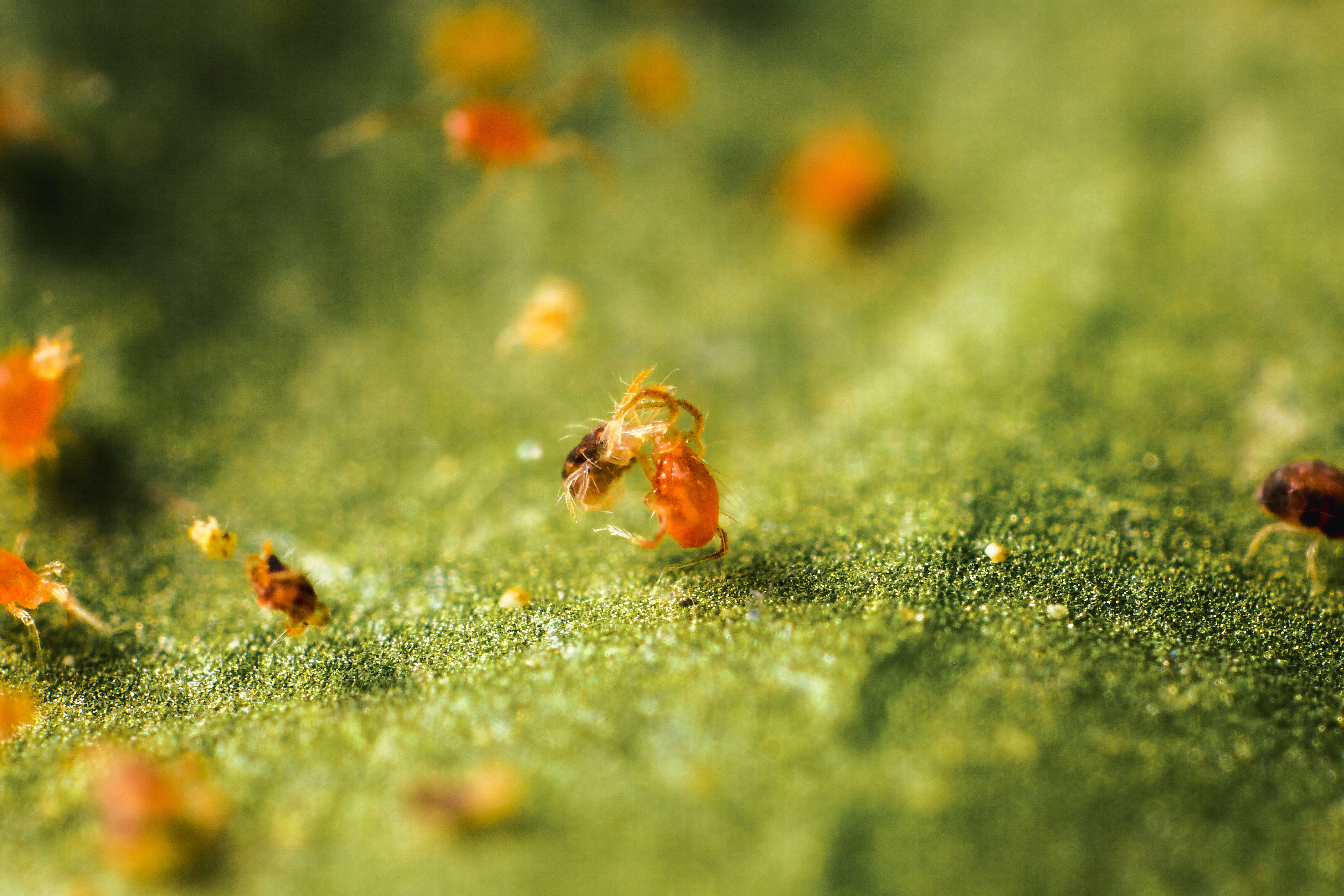
Spical (Neoseiulus californicus) is particularly valuable as the foundation of a biological spider mite programme because it can survive and establish when pest mite populations are low, as it can feed on alternative food sources, including other mites and pollen.
This feeding flexibility gives N. californicus an important advantage in berry crops. Rather than waiting for a large spider mite population to develop, growers can introduce Spical early, allowing predator populations to establish before the pest becomes economically damaging.
Spical is also more tolerant of higher temperatures and lower relative humidity than Phytoseiulus persimilis, making it particularly useful under warm production conditions.
As mentioned, Spical can establish and maintain a population even when spider mite pressure is low, making it a suitable option for preventative control. When introduced early, it can help suppress developing populations, reduce the risk of hotspots becoming established, and potentially reduce the need for corrective chemical applications.
Practical tip: Consider historical pest pressure, crop stage and seasonal weather conditions when planning preventative releases. Blocks with a history of spider mite problems or sections that regularly experience hot, dry conditions need more attention.
Spidex: A Specialist Predator for Corrective Control
 OLYMPUS DIGITAL CAMERA
During warm and dry conditions, spider mite populations can increase rapidly, often catching growers off guard. Once the pest population becomes high and damage is visible, reducing them to manageable levels can be difficult.
Spidex (Phytoseiulus persimilis) can provide a more targeted approach to controlling established spider mite populations. As a specialist predator, it feeds on Tetranychus urticae and has a high feeding rate and rapid reproductive response when prey is abundant.
These characteristics make Spidex particularly useful for corrective control across infested areas or in localised hotspots. However, its performance depends on suitable environmental conditions and sufficient prey availability. Compared with Spical, it is less tolerant of very high temperatures and low relative humidity.
The combination of Spical and Spidex therefore provides a complementary strategy: Spical establishes preventative control throughout the crop, while Spidex can be introduced when monitoring indicates that pest populations are increasing.
Practical tip: Do not wait until extensive webbing or severe leaf damage appears before responding to a hotspot. Mark affected areas, inspect the surrounding area, and assess whether targeted Spidex releases are appropriate or a release on the entire area is needed. Continue monitoring to determine whether the intervention is working.
Spical and Spidex: Complementary Predators, Not Competing Products
| Characteristic | Spical | Spidex |
| Predatory mite | Neoseiulus californicus | Phytoseiulus persimilis |
| Feeding behaviour | Generalist | Specialist spider mite predator |
| Main role | Preventative and maintenance control | Corrective and rapid suppression |
| Low pest populations | Can persist using alternative food sources | Requires spider mites as prey |
| High spider mite populations | Helps suppress population growth | Particularly effective when prey is abundant |
| Very high temperatures | More tolerant | Less tolerant |
| Low relative humidity | More tolerant | More sensitive |
| Best strategic use | Establish early and maintain | Target hotspots and increasing populations |
Protect your Predators
Successful biological control depends not only on releasing beneficial organisms, but also on protecting them after release. Many insecticides can have a direct or indirect effect on predatory mites. Before applying any pesticide, growers should check its compatibility with the biological control programme and consider its residual effects.
Koppert provides pesticide side-effect information to help growers determine the compatibility of crop protection products with beneficial organisms.
Where chemical intervention is unavoidable, the objective should be to select options that have the lowest possible impact on the established biological control programme and to integrate applications carefully into the overall IPM strategy.
Side effects on beneficials
| Active Ingredient | Aphipar | Lacewing | Thripex | Thripor-L | Spical | Spidex | Swirskii |
| Abamectin | 1 W | 1 W | 2 W | 1-6 W | 2 W | 1 W | 2 W |
| Azadirachtin | 0 W | 0 W | |||||
| Bacillus thuringiensis | |||||||
| Beauvaria bassiana | |||||||
| Chlorantraniliprole | |||||||
| Emamectin benzoate | 1 W | 0 W | 1 W | 1 W | 1 W | 1 W | 1 W |
| Indoxacard | 0 W | 2 W | 1 W | ||||
| Metarhizium anisopliae | |||||||
| Nucleopolyhedrovirus | |||||||
| Spinetoram | 2 W | 1 W | 1 W | 1 W | 2 W | 1 W | 2 W |
| Spinosad | 1 W | 1 W | 1 W | 1 W | 1 W | 2 W | |
| Spirotetramat | 1 W | 1 W | 1 W | 2-6 W |
Summary
- Scout early: Begin monitoring for red spider mite as early as possible to detect infestations before populations become established.
- Review chemical compatibility: Assess the active ingredients used previously and those planned for the season to ensure they are compatible with predatory mites and other beneficial organisms.
- Establish Spical: Introduce Spical early to establish a preventative predator population and help suppress developing spider mite populations.
- Monitor pest and predator populations: Track spider mite numbers, identify hotspots, and assess whether predatory mites are establishing and providing effective control.
- Introduce Spidex when required: If spider mite populations begin increasing or localised hotspots develop, consider targeted spider mite releases for more rapid suppression.
- Continue monitoring: Do not stop scouting after releasing predators. Regularly assess pest and predator populations to determine whether the biological control programme is working effectively.
- Protect beneficial organisms: Always check the direct and residual effects of insecticides and acaricides on predatory mites and other beneficial organisms before application.